Complete K-12 School Chemical Inventory Guide
2026 Edition
A comprehensive guide for K-12 science teachers, department chairs, science coordinators, laboratory managers, and school administrators to complete a safe, efficient, and compliant annual chemical inventory.
1. Why Chemical Inventory Management Matters
A chemical inventory is the foundation every other piece of laboratory safety sits on. Without an accurate, current one, a school cannot reliably do any of the following:
Complete a Chemical Hygiene Plan that actually reflects what’s on site
Confirm that a Safety Data Sheet exists for every chemical in the building
Identify incompatible chemicals stored next to each other
Give first responders an accurate picture during an emergency
Pass a fire marshal, Cal/OSHA, or CUPA inspection
Budget accurately for storage upgrades, disposal, or replacement purchasing
Demonstrate due diligence if a student or staff member is injured
But framing chemical inventory purely as a compliance exercise undersells its value. A well-run inventory program pays for itself in ways that have nothing to do with avoiding a citation.
Budget savings and purchasing efficiency. Departments without a current inventory routinely re-buy chemicals they already have, simply because nobody could confirm what was on the shelf. Multiply that across a district with a dozen sites, and the waste adds up quickly — not just in dollars, but in disposal costs down the road for the duplicate stock nobody uses.
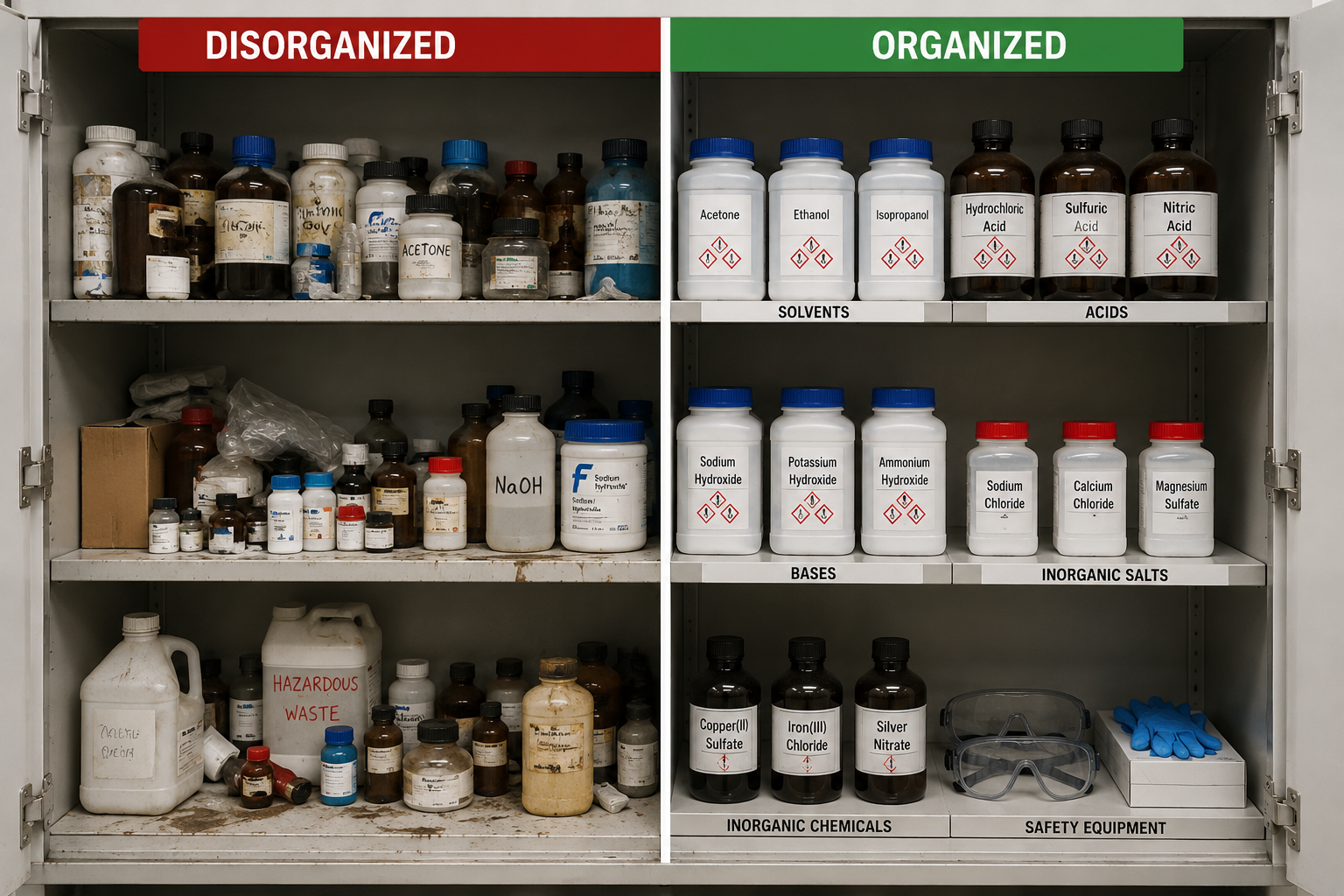
Hazard reduction. Most serious incidents in school science departments don’t happen during instruction — they happen because of what’s quietly sitting in storage: an aging ether that’s developed peroxides, an unlabeled container from a donation, two incompatible chemicals stored side by side because someone alphabetized the shelf. An accurate inventory is what lets you find and remove these risks before they become the cause of an incident rather than a footnote in one.
Emergency response and fire department coordination. If your building has a fire, chemical spill, or medical emergency, the difference between “here’s exactly what’s in this room, in what quantities, stored where” and “we’re not entirely sure” can shape how a response unfolds. Many fire departments and hazmat teams appreciate — and some jurisdictions require — a current chemical inventory on file that they can access before or during a response. This is worth establishing proactively with your local fire authority rather than during an actual incident.
Insurance and liability. In the event of an injury, fire, or regulatory investigation, an accurate, well-documented inventory and safety program is often the clearest evidence a district has that it exercised reasonable care. The absence of one, conversely, can become a central issue in litigation or an insurance claim dispute.
Teacher transitions. Science teachers change schools, retire, or move between grade levels more often than any inventory system built around one person’s memory can survive. When knowledge about “what’s really in that cabinet” lives only in one teacher’s head, it walks out the door the day they leave — and the replacement teacher inherits a room they don’t fully understand.
Laboratory planning. An accurate inventory is also a planning tool. It tells a department chair or facilities director what storage capacity is actually needed, what a renovation or new lab build needs to accommodate, and where a curriculum change might eliminate the need for an entire hazard category.
✅ Best Practice: Treat your chemical inventory as a living operational record, not a compliance artifact you update once a year under deadline pressure. The programs that work best update the inventory the moment a chemical arrives or leaves — not on a fixed annual date.
Organized and Disorganized K12 chemical storage cabinet