2. Who Owns This, and How Often Should It Happen
Who Should Perform the Inventory
In most schools, the physical inventory work is done by the teacher(s) who use the storage room day to day — they know the chemicals, the curriculum, and the space best. But performing the inventory and owning the program are different things, and conflating them is one of the more common structural mistakes districts make.
A durable program typically has three layers of responsibility:
RoleTypical ResponsibilitySite-level (teacher, department chair, or Chemical Hygiene Officer)Physical inventory counts, day-to-day storage and labeling, flagging issuesDistrict-level (safety officer, risk manager, or EHS coordinator)Policy, training standards, disposal contracting, cross-site consistency, regulatory reportingAdministrative (principal, facilities director)Budget support, scheduling, coordination with fire department and CUPA, ultimate accountability
Without a district-level owner, every site effectively runs its own version of a chemical safety program — which means quality varies enormously from school to school, and nobody notices when one site quietly falls behind.
How Often Should Inventories Be Performed?
Continuously (event-driven): Update the inventory the moment a chemical is received or disposed of. This is the single highest-leverage habit in the entire program.
Semesterly (spot-check): A lighter walkthrough comparing the digital record against a sample of physical storage locations.
Annually (full physical count): Every container in every storage location is verified against the digital inventory, without exception.
Following any major event: A renovation, a large donation, a teacher transition, or a multi-year gap in oversight all warrant an immediate full count rather than waiting for the next scheduled cycle.
What Happens When Inventories Are Inaccurate
The consequences compound quietly over time, which is exactly why the problem is so common:
Duplicate purchasing drains budget on chemicals already sitting on a shelf somewhere in the building.
Expired or degraded chemicals go unnoticed, including genuinely dangerous categories like peroxide-forming ethers, until someone happens to open the cabinet.
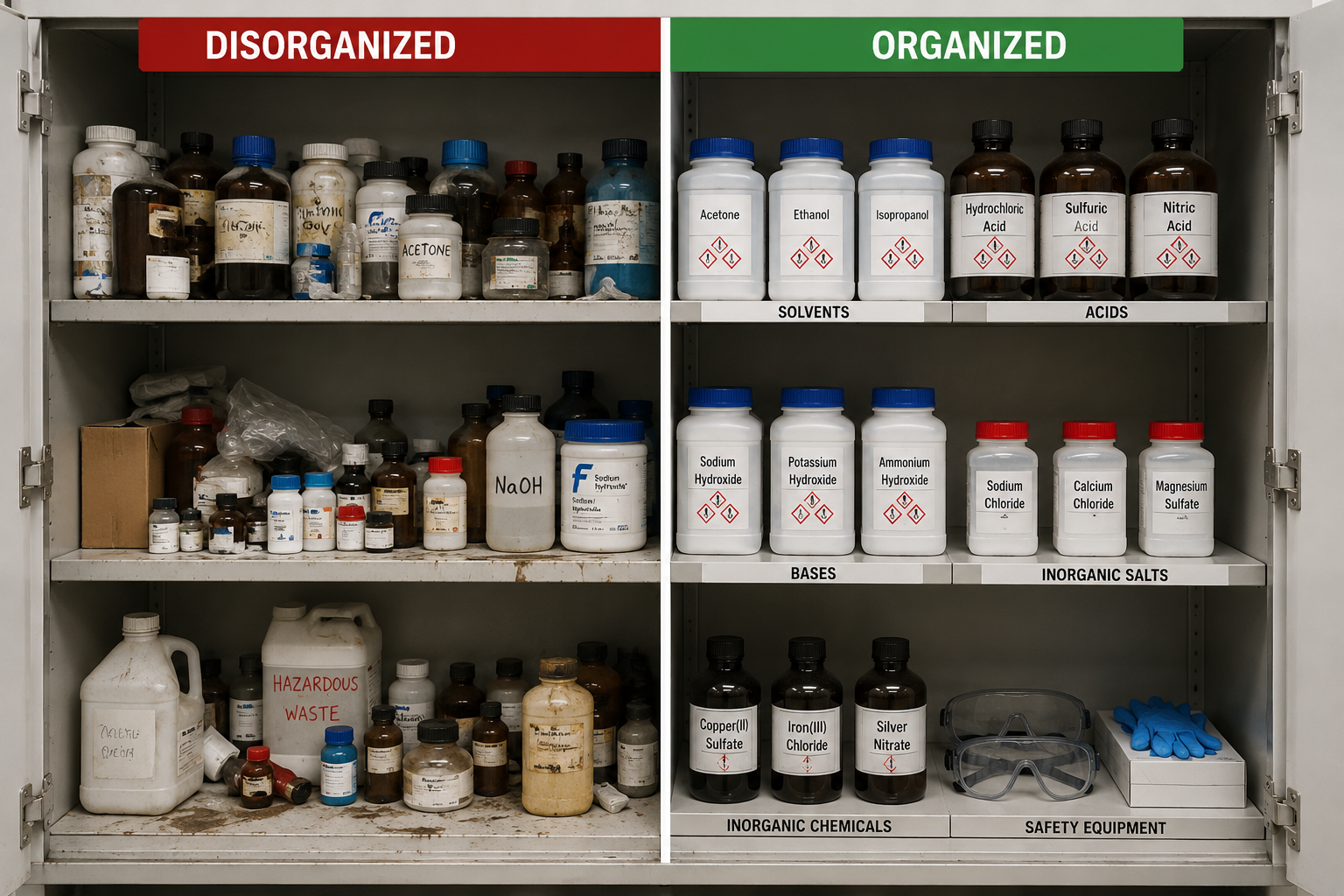
Incompatible chemicals end up stored together, often because a well-meaning reorganization defaulted to alphabetical order.
SDS gaps go undetected until an inspection or, worse, an actual exposure incident.
Inspections fail, sometimes over issues that would have taken minutes to fix if they’d been caught earlier.
Institutional knowledge disappears with staff turnover, and the next teacher starts from a position of not really knowing what they’ve inherited.
⚠️ Common Mistake: Many schools discover their inventory is inaccurate only when a new teacher arrives and starts asking questions the outgoing teacher never had to answer out loud. By then, the gap may have existed for years.
Internal link opportunity: “Chemical Hygiene Officer” → future article How to Designate and Train a School Chemical Hygiene Officer.