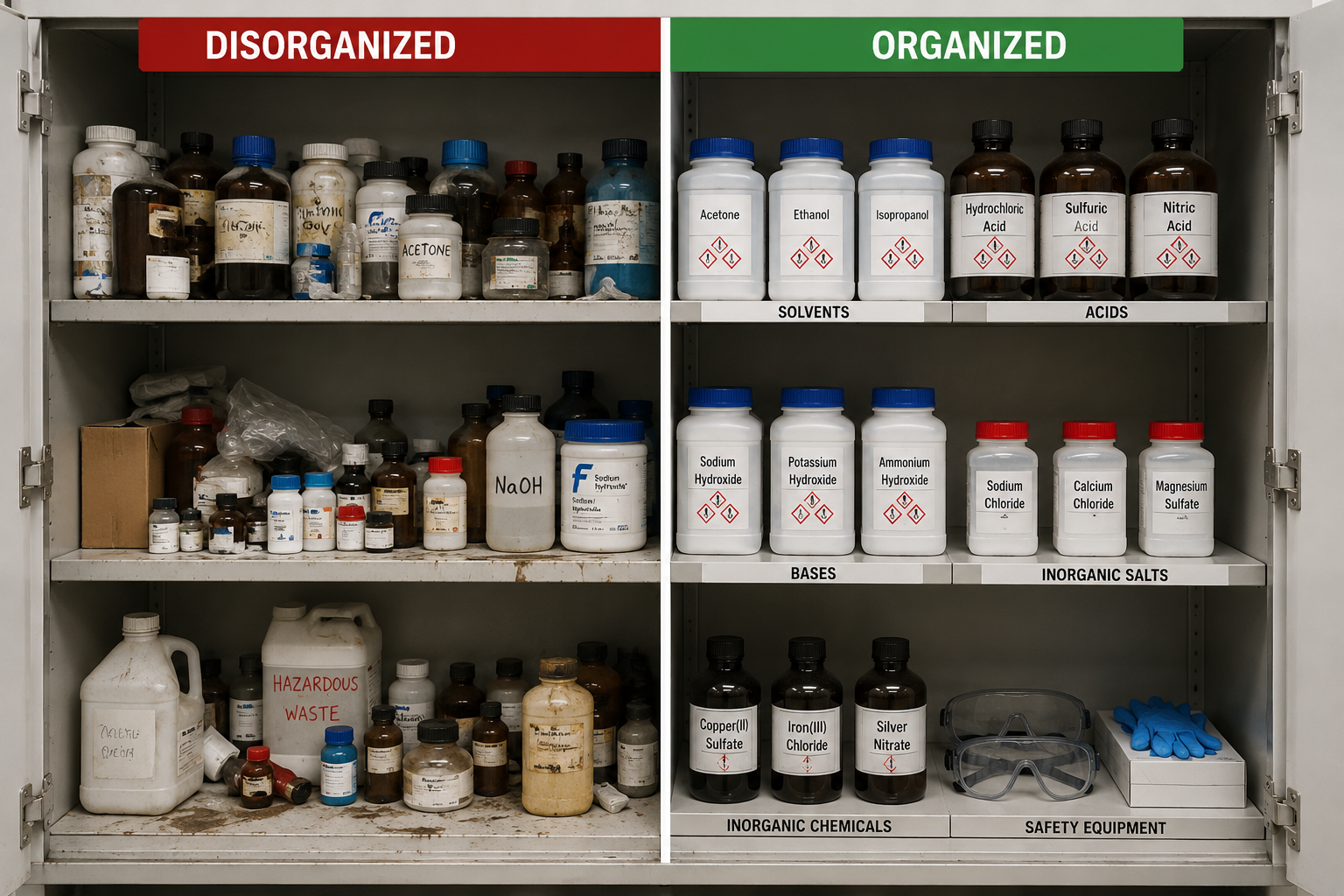
5. Chemical Storage and Compatibility
Improper storage — not classroom use — is the source of most long-term risk in a school chemical storeroom. Chemicals that are individually safe can become dangerous when stored next to the wrong neighbor.
⚠️ Common Mistake: Alphabetizing an entire storeroom is one of the most widespread and dangerous habits in school science. It routinely places incompatible chemicals side by side — a classic example is acetic acid ending up next to concentrated hydrogen peroxide simply because both start with similar letters. Alphabetize within compatibility groups, never across the whole room.
The Flinn Suggested Chemical Storage Pattern
Many U.S. schools organize chemical storage using the Flinn Scientific Suggested Chemical Storage Pattern, a compatible-family system that has been referenced by NIOSH’s School Chemistry Laboratory Safety Guide as a recommended approach to segregation. The system divides chemicals first into Inorganic (I) and Organic (O) families, and then into a series of numbered subgroups within each — separating, for example, acids from bases, oxidizers from organics, and reactive metals from aqueous solutions.
We’re intentionally not reproducing the full numbered group list here, because Flinn periodically revises it and it’s proprietary to their published materials — the safest move is to get the current version directly. Flinn Scientific publishes free wall charts and posters of the current pattern, and many chemical suppliers print the applicable storage code directly on the product label and SDS. If your storeroom doesn’t have a current chart posted, that’s worth fixing this month, not at the next inventory cycle.
Storage by Hazard Class
Whether or not you adopt a named system, every K–12 storeroom should segregate by these hazard classes at minimum:
| Hazard Class | Examples | Key Storage Notes |
|—|---|—|
| Flammables | Acetone, ethanol, hexane | Approved flammable storage cabinet; away from oxidizers and ignition sources |
| Oxidizers | Potassium permanganate, concentrated hydrogen peroxide | Separate from flammables and all organic material |
| Acids (inorganic) | Hydrochloric acid, sulfuric acid | Acid-resistant cabinet; separate from bases and active metals; nitric acid isolated from other acids |
| Acids (organic) | Acetic acid | Often segregated from inorganic acids and kept away from oxidizers |
| Bases/caustics | Sodium hydroxide, ammonium hydroxide | Separate from acids |
| Water-reactive materials | Sodium metal, calcium carbide | Cool, dry location, away from all aqueous solutions and sprinkler exposure |
| Peroxide-forming chemicals | Diethyl ether, tetrahydrofuran, isopropyl ether | See detailed guidance below — these require active date tracking, not just proper shelving |
| Toxic materials and carcinogens | Heavy metal compounds, certain dyes and stains | Locked, dedicated, restricted-access storage; minimize quantities kept on site |
| Compressed gases | Lab-supplied gas cylinders | Secured upright, chained or bracketed; valve caps in place when not in use; away from heat |
Peroxide-Forming Chemicals Deserve Special Attention
This is one of the most frequently overlooked hazards in school science departments, largely because the danger builds silently over time rather than announcing itself.
Certain organic chemicals — most commonly diethyl ether, tetrahydrofuran (THF), isopropyl ether, and dioxane — can slowly react with atmospheric oxygen to form peroxides, which become increasingly shock- and friction-sensitive as they concentrate. In extreme cases, an old, crystallized container of one of these chemicals has caused a serious explosion simply from being moved or opened.
What this means practically for a K–12 program:
Date every peroxide-forming chemical container on receipt, and again the first time it’s opened.
Purchase only what you’ll realistically use within the manufacturer’s recommended shelf life — large “just in case” bottles of ether-family solvents are a liability, not a convenience.
Store away from light and heat, tightly sealed, ideally in the original manufacturer container.
Unlike a university research lab, most K–12 programs do not have the trained EHS staff or equipment to safely test old peroxide-forming chemicals for peroxide concentration. If a container is past its recommended shelf life, shows crystals around the cap or threads, or has an unknown age, the safest path is to not move, shake, or open it and to call a licensed hazardous waste contractor for professional handling — treat it the same way you would treat any unknown, high-risk chemical.
⚠️ Common Mistake: An old bottle of ether sitting untouched in the back of a cabinet feels low-risk precisely because nothing has happened yet. That’s exactly the profile of the containers that cause the most serious peroxide-related incidents nationally.
Carcinogens and Reproductive Toxins
A small number of chemicals still found in some older K–12 inventories are now recognized carcinogens, mutagens, or reproductive toxins and should generally be phased out of instructional use entirely rather than simply stored more carefully. If your inventory turns up chemicals in this category left over from an older curriculum, treat replacement or removal as a priority rather than a “someday” project — modern lab curricula have safer substitutes for nearly every legacy demonstration that historically used them.
Compressed Gases
School labs that use compressed gas cylinders (for burners, certain demonstrations, or specialized equipment) should:
Secure every cylinder upright with a chain or bracket at all times, including “empty” ones
Keep the protective valve cap on whenever the cylinder isn’t connected for use
Store away from heat sources and out of high-traffic pathways
Confirm regulators and fittings are inspected on a documented schedule
Checklist: Chemical Storage Review
Chemicals grouped by compatibility, not alphabetically across the room
Flammables in an approved, ventilated flammable storage cabinet
Acids and bases physically separated
Oxidizers isolated from organics and flammables
Peroxide-forming chemicals dated and within shelf life
Toxic materials/carcinogens in locked, restricted storage
Compressed gas cylinders secured upright with valve caps in place
Secondary containment trays used for liquids
Current storage pattern chart posted and visible
Maximum allowable quantities per fire code confirmed with local fire authority
[Diagram recommendation: labeled storeroom diagram showing hazard-class zones, styled as a printable storeroom poster.]
Internal link opportunity: “storage compatibility” → Chemical Storage Compatibility Chart for School Science Labs; “peroxide-forming chemicals” → Managing Peroxide-Forming Chemicals in School Science Labs.