9. Identifying and Disposing of Unwanted Chemicals
Every long-running science department eventually accumulates chemicals that no longer belong — expired reagents, discontinued-course leftovers, unknowns from old donations. Handling these correctly is one of the highest-stakes parts of the entire program.
Chemicals That Warrant Priority Removal
Picric acid and similar chemicals that can become shock-sensitive as they dry
Aging ether-family solvents at risk of peroxide formation (see Section 5)
Elemental mercury and mercury compounds
Chemicals banned or restricted from K–12 instructional use by your state department of education
Any unlabeled or unidentifiable container
Chemicals with no remaining curricular use
Understanding Your Hazardous Waste Generator Status
Your allowed storage and disposal timelines depend on your generator category, which the EPA and California DTSC calculate monthly — not on total annual volume.
Most K–12 science departments fall in the SQG range in California, but a single large cleanout — clearing a storeroom that hasn’t been purged in decades — can temporarily push a district into LQG territory for that month. Federal rules include “episodic event” provisions designed for exactly this situation; it’s worth understanding them before scheduling a major cleanout.
The Practical Disposal Process
Inventory and segregate unwanted chemicals by compatibility group — never combine unknowns.
Contact your CUPA or district EHS office before disposal begins, especially for a large cleanout.
Engage a licensed hazardous waste contractor for pickup, packaging, and manifesting. School staff should not attempt to combine, neutralize, or dispose of hazardous chemicals themselves.
Retain manifests and disposal records as compliance documentation.
Update the inventory immediately once chemicals leave the site.
Many states and some California county programs periodically offer school chemical cleanout assistance to help offset disposal costs for legacy stockpiles — worth researching before a large one-time purge.
| Category |
Federal Threshold (per month) |
Key Requirement |
|---|---|---|
| Very Small Quantity Generator (VSQG) | ≤100 kg non-acute and ≤1 kg acutely hazardous waste | Fewest federal requirements. California has not adopted this exemption, so California schools at this volume still meet SQG-level standards. |
| Small Quantity Generator (SQG) | Between 100 kg and 1,000 kg non-acute | Up to 180-day on-site accumulation—or 270 days if shipping more than 200 miles—and a 6,000 kg on-site cap |
| Large Quantity Generator (LQG) | ≥1,000 kg non-acute, or >1 kg acutely hazardous | 90-day accumulation limit; formal contingency plan and expanded training |
⬅ Chapter 8 Chapter 10 ➡
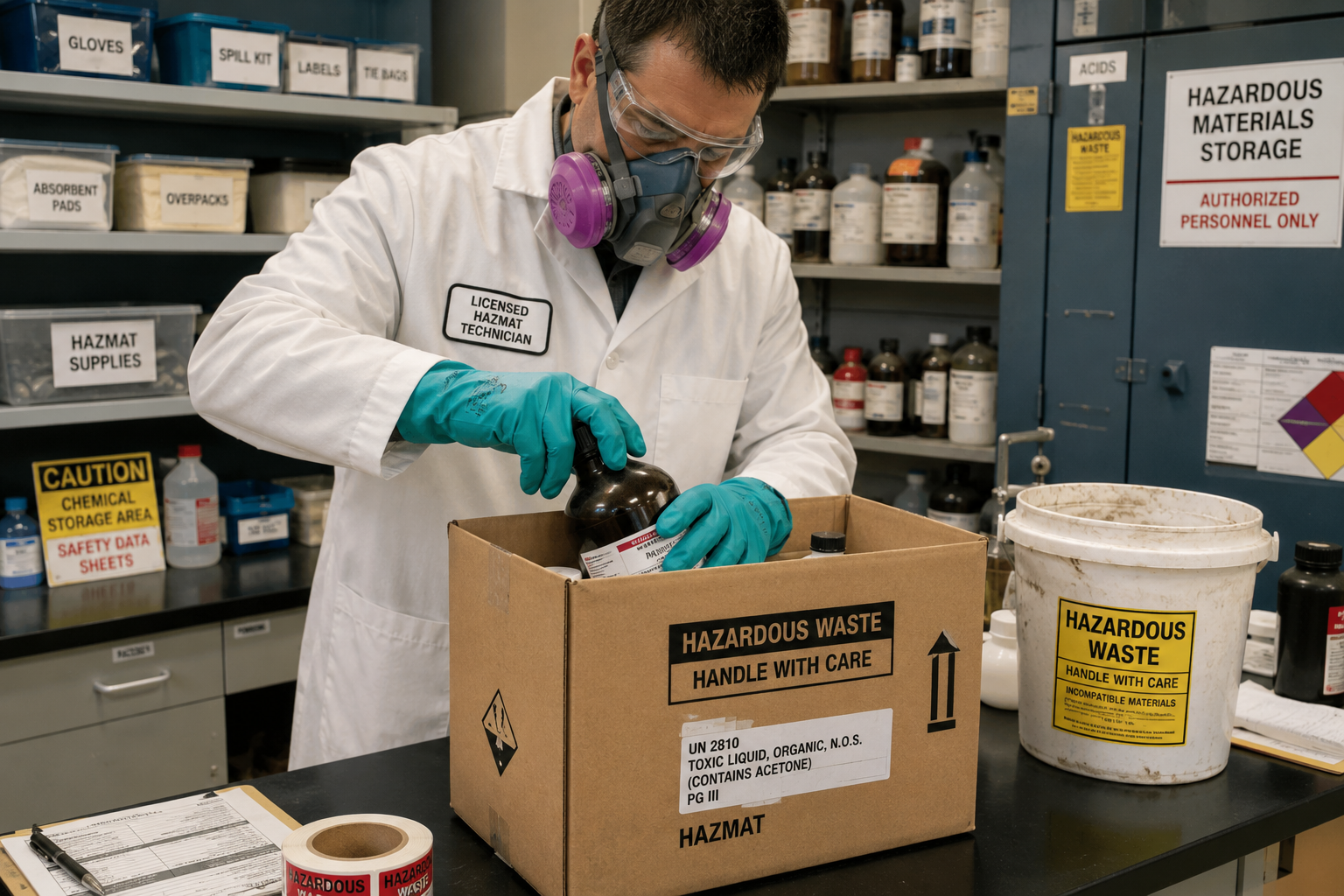
Proper disposal of unwanted chemicals begins with accurate identification, segregation, and safe packaging. Following established hazardous waste procedures protects staff, students, and the environment while helping schools maintain compliance with appropriate regulation